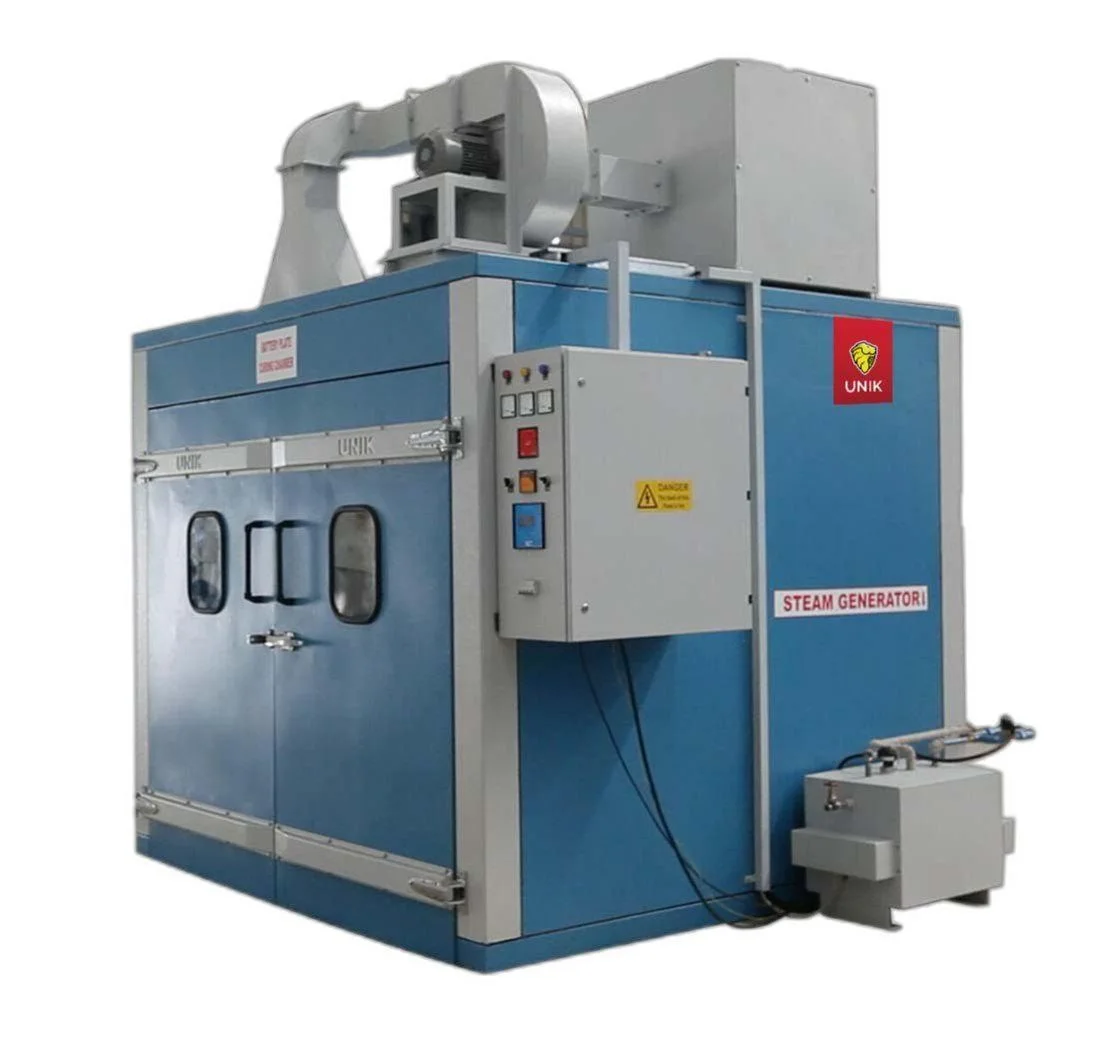
Ask a plant manager what their curing chamber runs at and they will quote a temperature within a couple of degrees. Ask about relative humidity and the answer is usually a pause, then a number taken from the commissioning report three years ago.
Curing is not a drying step. It is a controlled recrystallisation of the active material, and it needs both heat and moisture. Run it too dry and the paste sets as a brittle, cracked layer that sheds material in service. Run it too wet and you never reach the handling strength you need to pick the plate up without damage.
What actually happens during curing
- Free water leaves. The plate loses the bulk of its water in the first hours. Airflow does this, not temperature.
- Tetrabasic lead sulphate forms. This is the step that gives you the crystal structure you want, and it is humidity-sensitive.
- Oxidation completes. Free lead converts. Incomplete conversion shows up as a formation problem weeks later.
- The plate dries to handling strength. Only now should the temperature come up for the final dry.
A chamber that simply ramps to a single setpoint and holds it does steps two and three badly, because the moisture the plates need early is being extracted by the same airflow that is needed later.
The fix is instrumentation, not a new chamber
Most chambers in service can be made substantially better with three changes:
- Measure RH at plate level. A sensor on the wall measures the wall. Put a logging sensor in a rack position, and log it through a full cycle.
- Stage the airflow. High airflow early to remove free water, reduced airflow through the crystallisation window, high airflow again at the dry stage. A damper and a schedule cost very little.
- Log the door. Every door opening is a step change in both temperature and humidity. A €30 reed switch on the door tells you which shift is costing you plates.
Before you buy a new chamber, log the one you have for a week. The curve usually explains the problem better than the specification sheet does.
What good looks like
A healthy cycle shows a fast initial humidity drop, a plateau where the RH stays deliberately high for the crystallisation window, then a controlled fall to the dry stage. Temperature rises only after the plateau. If your log shows a straight line from start to finish, the chamber is doing one thing and the plates need three.
A note on loading
Chamber performance is a function of load as much as of setpoint. A cycle tuned with a half-full rack will under-cure a full rack. Establish the recipe at the load you actually run, and if you routinely run partial loads, keep two recipes.