Company
Curing Chamber
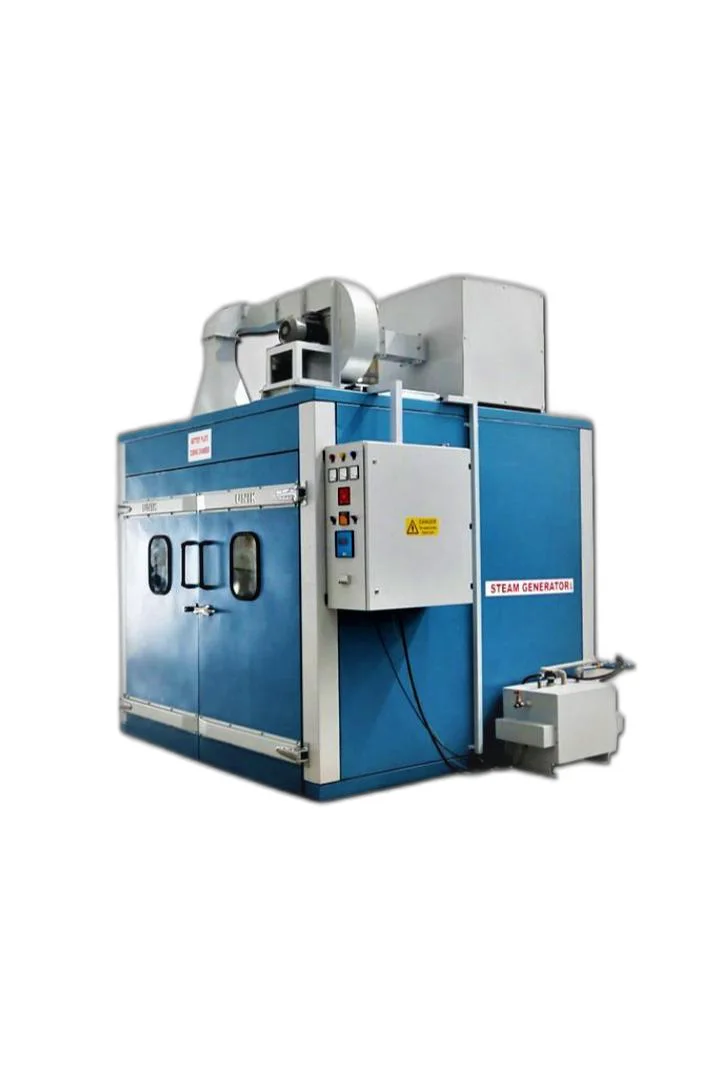
A curing chamber holds pasted plates at controlled temperature and humidity long enough for the paste to convert to basic lead sulphates, then dries them without cracking.
In short: a curing chamber is an insulated room with temperature, humidity and air-circulation control in which pasted plates stay 24–72 hours while the paste converts to 3BS/4BS crystals and free lead falls. Unik builds walk-in chambers in PP-lined or painted-MS construction, sized to the plate racks your line actually produces.
Curing is a chemical step, not a drying step
Paste leaves the paster wet and largely unreacted. Inside the chamber, at roughly 40–50 °C and high relative humidity, lead oxide converts to tribasic and tetrabasic lead sulphate. The 3BS/4BS ratio decides how the plate behaves in formation: more 4BS gives a stronger, longer-lived plate but needs a slower, wetter cure.
Only after conversion does the chamber switch to drying, at higher temperature and low humidity. Dry too early and the paste skin sets while the core is still wet — the plate cracks, and it sheds material in the formation tank. That is why the recipe, not the thermostat, is the important control on the panel.
Specifications
| Parameter | Curing stage | Drying stage |
|---|---|---|
| Temperature | 40 – 50 °C | 60 – 75 °C |
| Relative humidity | 85 – 98 % | Below 30 % |
| Uniformity | ±2 °C, ±5 % RH | ±3 °C |
| Air changes | Recirculation with fresh-air bleed | Forced, 6 – 12 ACH |
| Internal volume | 8 – 40 m³ per chamber | Integral or separate oven |
| Control | PLC with one recipe per plate type | PLC, logged |
| Construction | PP-lined or painted MS, PUF insulated | Painted MS, PUF insulated |
Chamber, oven, or both
A curing chamber is not interchangeable with a drying oven: the chamber has to hold humidity at 90 % for a day or more, which a normal oven cannot do. Where floor space is tight we build a two-stage chamber with an internal partition, or a separate electric curing chamber for sites without steam. Humidity control is also why the chamber is the machine most worth instrumenting: one wet-bulb probe drifting 5 % will change your 4BS ratio without any visible alarm.
Questions buyers ask
Frequently asked questions
How long does plate curing take?
Typically 24–48 hours of curing at 40–50 °C and high humidity, followed by 12–24 hours of drying, depending on plate thickness and the 4BS level you want. Thick tubular plates at high 4BS need the long end of that range.
Why is humidity controlled instead of just temperature?
Conversion to basic lead sulphate needs water present. Run the chamber dry and the surface paste skins over, conversion stops part-way, and free lead stays high — which shows up later as inconsistent capacity and short shelf life.
Can one chamber cure pasted and tubular plates?
Yes, with separate recipes and racking. Tubular plates are usually cured with higher humidity and longer time, so batches are not mixed within one cycle. We set the recipes at commissioning against your own plate samples.
How is the chamber heated?
Electric heaters with a steam or hot-water coil option. For sites with no steam line, the electric curing chamber is the usual choice; running cost then depends on insulation quality and air-change rate more than on heater size.
Still unresolved? Send the plate drawing or the load profile and we will answer with numbers rather than a brochure. Request a quotation →
Next step
Tell us the cells you need to build,
and the plant you need to run them.
Send your capacity target, cell format and the operations you want to bring in-house. We will come back with a machine list, a layout and an indicative timeline.
What helps us quote fast
- Cell format and dimensions (cylindrical, pouch, prismatic, tubular)
- Target throughput per shift, and annual volume
- Which steps you already run, and which are new
- Shop-floor power supply and available footprint
- Destination port and required commissioning window